

On this page

When Is COPD Considered a Disability?
Yes, chronic obstructive pulmonary disease (COPD) can be a disability. It is considered a disability when it limits daily life or makes steady full-time work unrealistic.
Under the Americans with Disabilities Act (ADA), a condition is a disability if it substantially limits a major life activity like breathing. A lot of people with moderate to severe COPD meet that bar. COPD includes emphysema and chronic bronchitis, which can range from mild to very severe.
For the Social Security Administration (SSA), the question is different: can you do steady paid work for at least 12 months (what SSA calls Substantial Gainful Activity, or SGA)? If severe COPD keeps you from any full-time job, you may qualify for SSDI or SSI. A diagnosis alone is not enough. The decision hinges on lung tests and how your symptoms limit you day to day. Mild COPD usually does not qualify.
Key takeaway: COPD is considered a disability when it substantially limits breathing or prevents full-time work for 12 months or more.
Social Security Disability Benefits for COPD
You can get Social Security disability (SSDI or SSI) for COPD in two ways: by meeting the medical listing or by proving your symptoms make any full-time work impossible.
Meeting the SSA's Medical Criteria (Listing 3.02)
- SSA's Blue Book Listing 3.02 for chronic respiratory disorders sets strict criteria. If you meet the listing, SSA generally considers you disabled for benefit purposes.
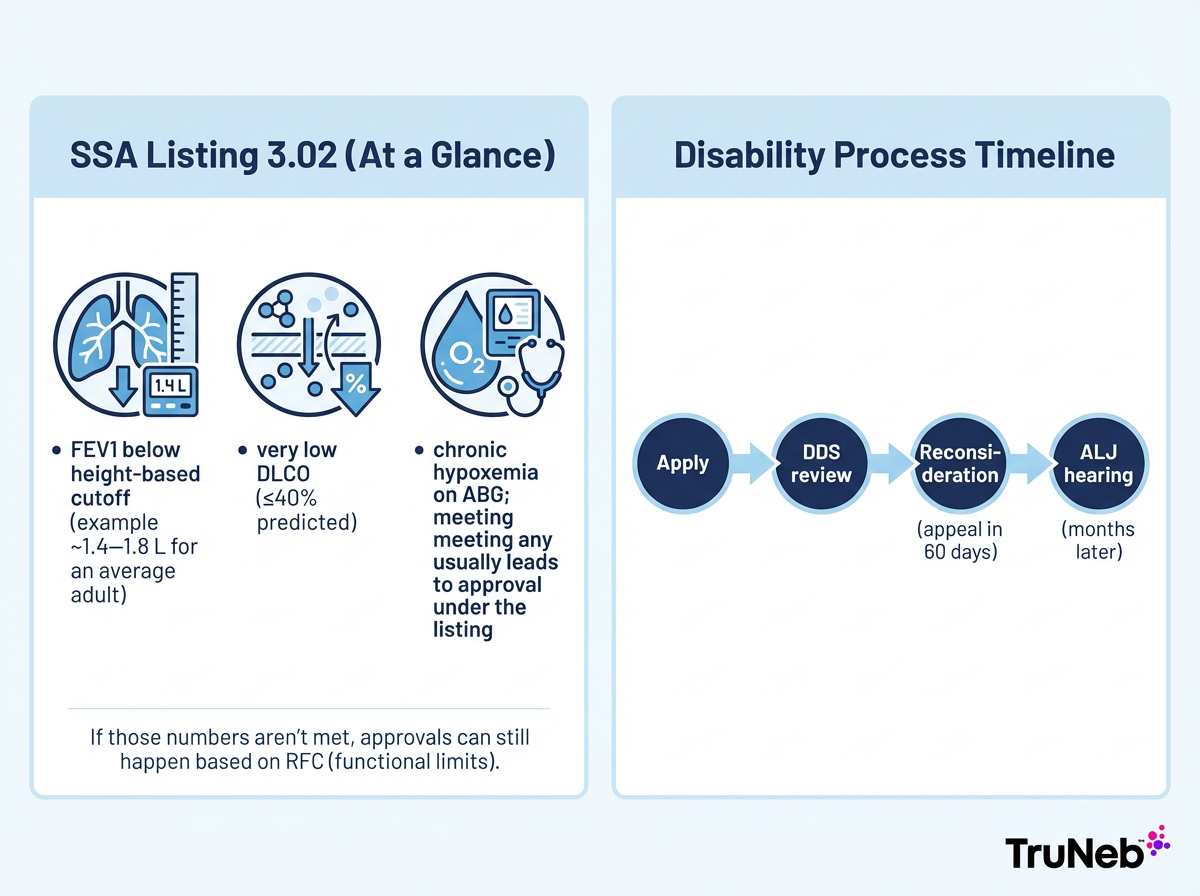
- It focuses on very low lung function numbers on pulmonary function tests, like FEV1 below the cutoff for your height. As a rough example, some average-height adults meet the listing around ~1.4–1.8 L or less.
- Other paths include very low DLCO or certain arterial blood gas (ABG) findings that show chronic hypoxemia.
- These thresholds are strict and signal very severe disease.
Qualifying Based on Functional Limits
- When your lung test numbers do not meet the listing, SSA still looks at your Residual Functional Capacity (RFC): what you can reliably do, 5 days a week.
- Limits that matter: getting winded after a few minutes of walking, needing frequent breaks, needing to avoid dust/fumes/extreme temperatures, frequent exacerbations, or needing breathing treatments during the workday.
- If your RFC shows you cannot even do a simple sit-down job consistently, you can still be approved.
Medical Evidence You will Need
These records help SSA understand why everyday tasks like walking across a room or climbing a few stairs leave you short of breath.
- Spirometry reports (FEV1/FVC) over time.
- Doctor's notes with COPD diagnosis and treatments tried (inhalers, nebulizer use, oxygen, pulmonary rehab).
- Imaging or labs (e.g., CT signs of emphysema, arterial blood gas (ABG) tests if done).
- Oxygen prescription or saturation readings.
- ER visits/hospitalizations for exacerbations.
- Detailed notes describing what you cannot do (e.g., must stop after 100 feet, needs nebulizer four times daily). Ask your pulmonologist to document these limits.
Key takeaway: SSA approves COPD disability claims either by strict Blue Book numbers or by showing, through RFC, that you cannot sustain regular full-time work.
| Path to approval | What SSA evaluates | Common medical evidence | Typical outcome | Notes |
|---|---|---|---|---|
| Blue Book Listing 3.02 | Very low FEV1 for height, very low DLCO, or chronic hypoxemia on ABG | Spirometry, DLCO test, arterial blood gas (ABG), oxygen prescription | If criteria are met, SSA generally considers you disabled | Strict numbers that reflect very severe impairment |
| RFC / Medical-vocational allowance | Day-to-day limits and whether you can sustain simple full-time work | Doctor notes on limits, spirometry trend, oxygen use, ER/hospital records | Approved if evidence shows you cannot maintain regular work reliably | Age, education, and past work also factor into the decision |
Note: Exact FEV1 cutoffs vary by height and sex; SSA uses standardized reference tables.
How to Apply (SSDI vs. SSI)
- Apply online through the Social Security Administration website or through your local office.
- SSDI is based on work credits; SSI is needs-based. You can apply for both and let SSA decide.
- A state Disability Determination Services (DDS) team reviews your file and may schedule a consultative exam (CE) with one of their doctors if more information is needed.
- Initial decisions usually take a few months.
- Approvals require SSA to expect your COPD-related limitations to last at least 12 months, and cases can be reviewed periodically.
If Your Claim Is Denied (Appeals)
- Appeal within 60 days. First is reconsideration. If denied again, request a hearing with an Administrative Law Judge (a large share of claims are won there).
- A disability attorney or advocate can help gather evidence and present your case.
Key takeaway: You can qualify for Social Security disability benefits by meeting Listing 3.02 or by showing your COPD-related limits make any full-time work unrealistic.
What Stage of COPD Qualifies for Disability?
GOLD stages (from the Global Initiative for Chronic Obstructive Lung Disease) describe severity, but Social Security does not approve or deny based on the stage label alone. They look at what you can do.
Rule of thumb:
- Stage 1 (Mild, FEV1 >= 80%): usually not disabling.
- Stage 2 (Moderate, 50-79%): people can still manage light work.
- Stage 3 (Severe, 30-49%): usually very limiting; people frequently qualify based on functional limits.
- Stage 4 (Very severe, <30% or <50% with chronic respiratory failure): typically disabling; commonly meets the listing criteria or clearly prevents full-time work.
Red flags outside the stage label include frequent hospitalizations, needing continuous oxygen, or being unable to walk short distances without stopping.
Key takeaway: SSA cares most about how COPD affects your function, and most approvals involve severe or very severe COPD, especially if oxygen is needed or flare-ups are frequent.
COPD and Veterans: VA Disability Ratings
If your COPD is service-connected, the VA can award disability compensation separate from Social Security.
How the VA rates COPD:
- The VA uses a percentage system (0%-100%) based on the worst result among several measures (FEV1 % predicted, FEV1/FVC, or DLCO) and your symptoms.
- Common brackets: about 10% (mild), 30% (moderate), 60% (severe), and 100% (very severe or continuous oxygen). Continuous oxygen use usually corresponds to higher ratings.
Key differences:
- VA ratings can be partial (for example, 30% or 60%) and are independent of SSA's all-or-nothing approach.
- You can receive both VA compensation (service-connected) and SSA disability if you qualify under each program.
What to do:
- File a VA claim with service records and medical evidence. Be ready for a Compensation & Pension (C&P) exam.
- Include any service exposure history (burn pits, dust, fumes) that started or worsened your COPD.
Key takeaway: The VA assigns a 0%-100% rating for service-connected COPD; SSA is all-or-nothing.
Working with COPD: Your Rights and Accommodations
You don't always need to stop working. If COPD substantially limits breathing or your ability to be active, the ADA can require your employer (15+ employees) to offer reasonable accommodations so you can do your job. You can have ADA protections even if you're not on SSDI/SSI.
Practical ideas:
- Environment changes: avoiding dust, fumes, smoke, or extreme temperatures; better ventilation or an air purifier; moving to a cleaner area.
- Schedule and logistics: extra or flexible breaks to use an inhaler or nebulizer; remote work options or flexibility on bad air-quality days; closer parking to reduce walking.
- Role adjustments: lighter duties if heavy exertion triggers symptoms.
Employers must engage in an interactive process to find solutions that do not cause undue hardship. FMLA can also help: eligible workers can take job-protected, unpaid leave for serious health issues like COPD flares.
Key takeaway: If COPD substantially limits breathing, the ADA can require reasonable job accommodations.
Living Well with COPD While You Navigate Disability
Good symptom control can make daily life easier, whether you apply for benefits or keep working.
What tends to help:
- Follow the treatment plan you and your doctor have set, including maintenance inhalers, rescue medications, and pulmonary rehab if it is part of your care.
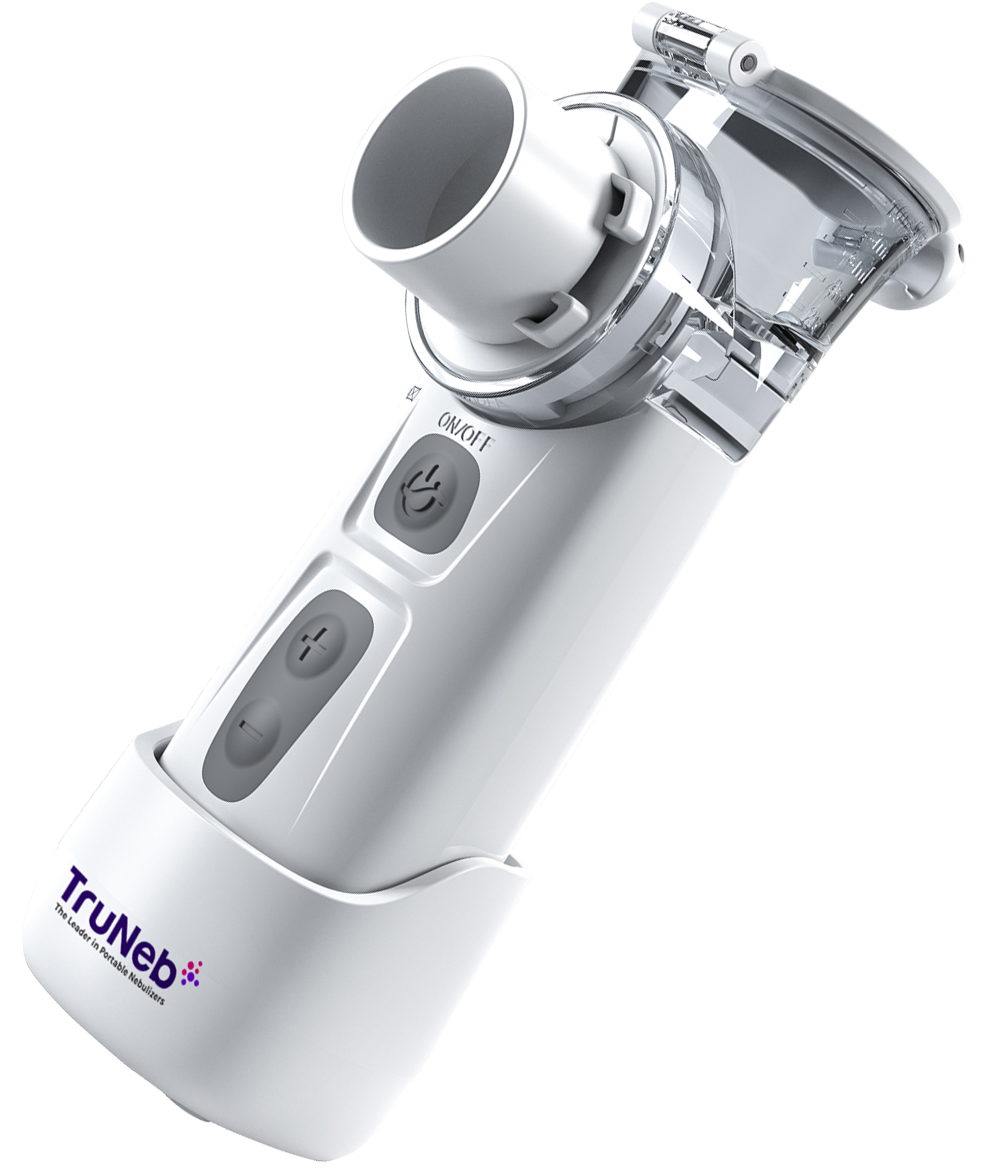
- Some people use at-home tools for COPD: a portable mesh nebulizer can deliver doctor-prescribed bronchodilators or saline on the go. Simple, quick treatments can help you stay on schedule at work or when traveling.
- Clear mucus when it builds up: some doctors prescribe 3% or 7% hypertonic saline via nebulizer to help thin secretions.
- It helps to avoid smoke and irritants, keep your vaccines up to date, and stay as active as your doctor recommends.
- Mind your energy and mood: pace tasks, rest between activities, and use support groups if stress or worry builds.
Related conditions like emphysema, chronic bronchitis, heart disease, or sleep apnea can worsen your overall limits and, for SSA, can strengthen the total picture of your disability claim.
⚠️ Do not confuse steam inhalers with nebulizers. Steam devices are not meant for breathing prescription COPD medications.
Important: better control can help you function day to day, but disability decisions still depend on how limited you are despite treatment.
Safety note: Talk to your doctor before trying a new medication.
⚠️ If you have severe shortness of breath at rest, chest pain, confusion, or blue lips or fingernails, seek emergency medical care right away.
Talk to your doctor if your COPD symptoms get worse, you are having more flare-ups, or you are thinking about changing your treatment plan.
Disclaimer: This article is for informational purposes only and is not a substitute for professional medical or legal advice. Always talk to your doctor about your health and treatment options, and consult a qualified disability attorney or advocate about your specific benefits claim.
Frequently Asked Questions
Tap or click a question below to see the answer:
No. COPD is considered disabling when it substantially limits breathing or prevents steady full-time work for at least 12 months. SSA can approve you under Blue Book Listing 3.02 or, if the numbers are not met, through RFC when your functional limits rule out regular work.
Yes, but only if your countable earnings stay below Substantial Gainful Activity (SGA) and your medical limits show you cannot sustain regular work. Talk with your doctor about your capacity and consider speaking with a disability advocate.
You do not need a lawyer, but a lot of people find an attorney or advocate helpful, especially at the hearing stage. Fees are typically contingency-based and capped by SSA.
They can. SSA considers the combined effect of all medically determinable impairments, so conditions like emphysema, chronic bronchitis, asthma, heart disease, or sleep apnea can add to your overall limitations.
Key takeaway: Better symptom control helps daily life, but disability status depends on your limits despite treatment.