

On this page
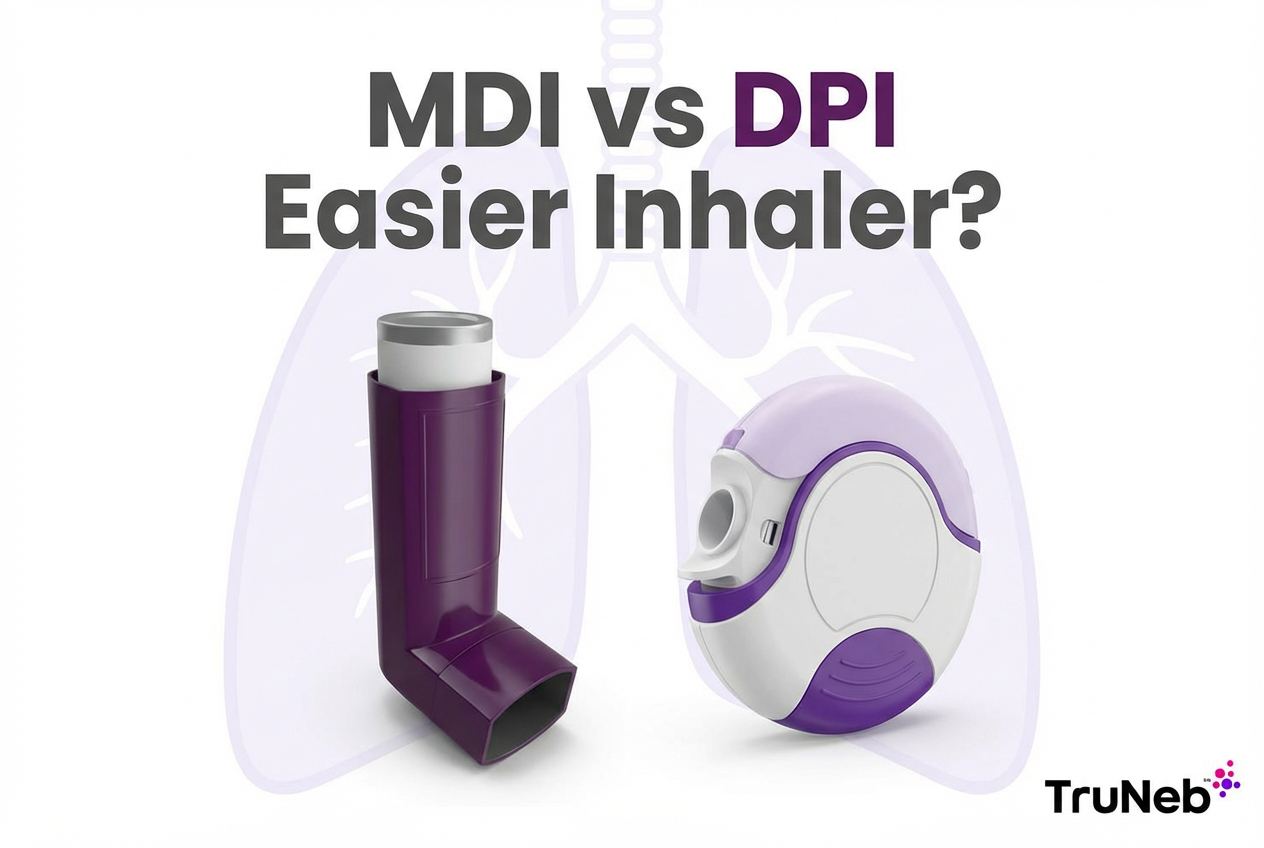
What Are MDIs and DPIs?
An MDI (metered-dose inhaler) is a spray inhaler with liquid medicine in a pressurized canister. A DPI (dry powder inhaler) holds medicine as fine powder that you breathe in.
Both send medicine straight to your lungs for conditions like asthma and COPD. The core difference is how the dose moves: an MDI uses a propellant to push out a mist, while a DPI uses your quick, deep breath to pull the powder in. Both device types can deliver bronchodilators and inhaled corticosteroids (daily controllers).
There’s also a third type called a soft mist inhaler, but this article focuses on the two most common types: MDIs and DPIs.
In short, MDIs spray liquid medicine as a mist, while DPIs let you inhale medicine as a dry powder.
How a Metered-Dose Inhaler (MDI) Works
An MDI has a metal canister (with medicine and HFA propellant) in a plastic holder. When you press the canister, one measured puff of mist comes out. For best results, start a slow, deep breath and press at the same time so the medicine reaches your lungs. Most MDIs need a gentle shake first; always check your inhaler’s instructions because not every MDI needs to be shaken.
If timing is hard, a spacer can make it easier to breathe in the medicine correctly.
In simple terms, an MDI uses a pressurized canister to spray a measured mist of medicine as you breathe in slowly.
How a Dry Powder Inhaler (DPI) Works
A DPI is breath‑actuated (it works when you breathe in fast and deep). There is no propellant. You prepare the dose (twist, click, or pierce a capsule depending on the device). Then you take one quick, deep breath to pull the powder into your lungs.
Most DPIs include a dose counter so you can see what is left. Because the medicine is a dry powder, DPIs work best when kept away from moisture or steam. Spacers are not used with DPIs.
A DPI relies on your own fast, deep breath to pull powdered medicine from the device into your lungs.
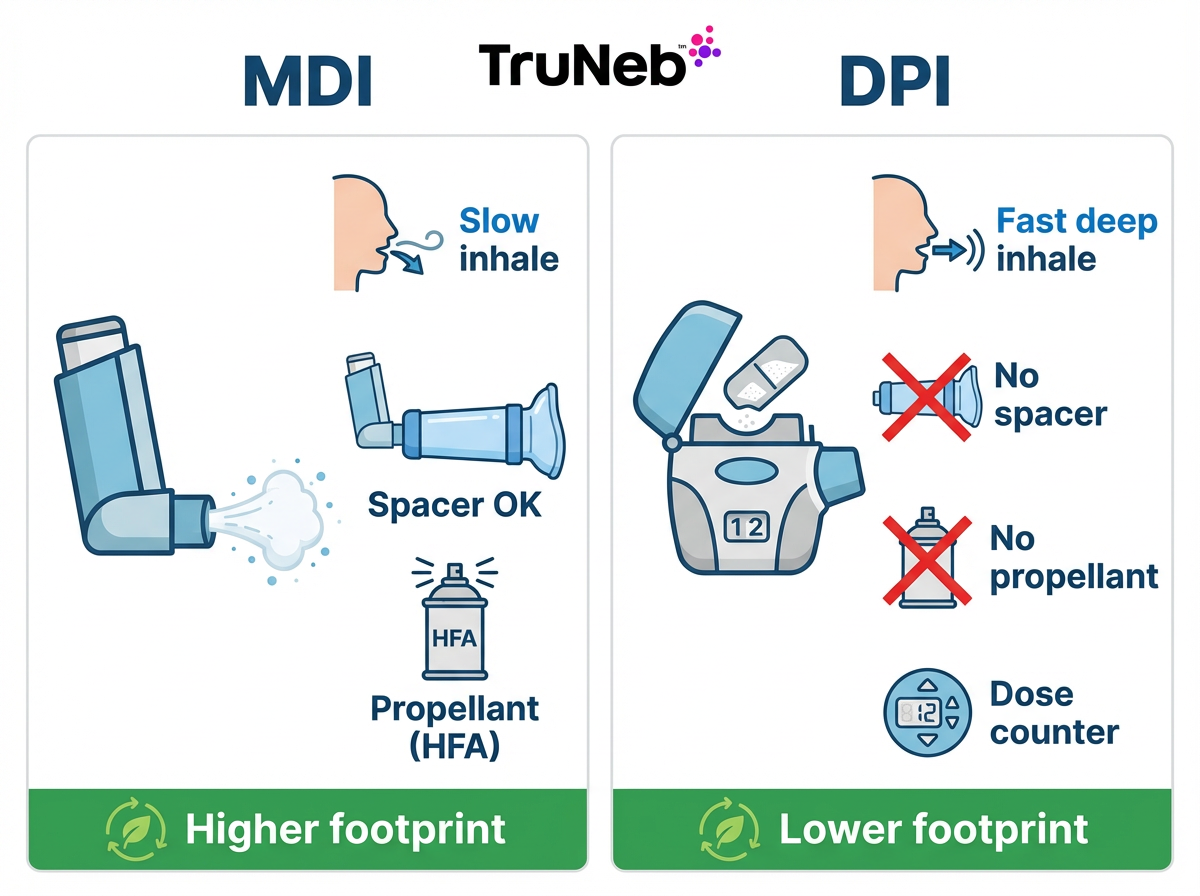
MDIs spray a mist you inhale slowly; DPIs deliver powder you inhale fast and deep.
| Factor | MDI (Spray Inhaler) | DPI (Dry Powder Inhaler) |
|---|---|---|
| Medicine form | Liquid mist (aerosol) | Fine powder |
| Dose release | Press the canister | Breath‑actuated by a quick, deep inhale |
| Inhale speed | Slow and steady | Fast and deep |
| Coordination | Press and breathe together | No press timing needed |
| Spacer | Can use a spacer | Not used with DPIs |
| Dose counter | Usually not built‑in | Usually built‑in |
| Humidity | Generally not sensitive to humidity | Moisture can clump powder |
| Cleaning/storage | Clean mouthpiece weekly; room temp | Keep dry; don’t wash inside |
| Common use | Common for rescue medicines; also used for some controllers | Common for controller medicines and some combination inhalers |
| Cost & insurance | Commonly available as generics; some plans prefer MDIs | Some DPIs are brand‑only and can be higher cost; insurance plans sometimes switch between device types |
| Environment | Uses HFA propellant (higher footprint) | No propellant (lower footprint) |
Key point: MDIs need a slow, coordinated inhale; DPIs need a fast, deep inhale.
Both deliver medication effectively when used correctly.
Using a Metered-Dose Inhaler Correctly
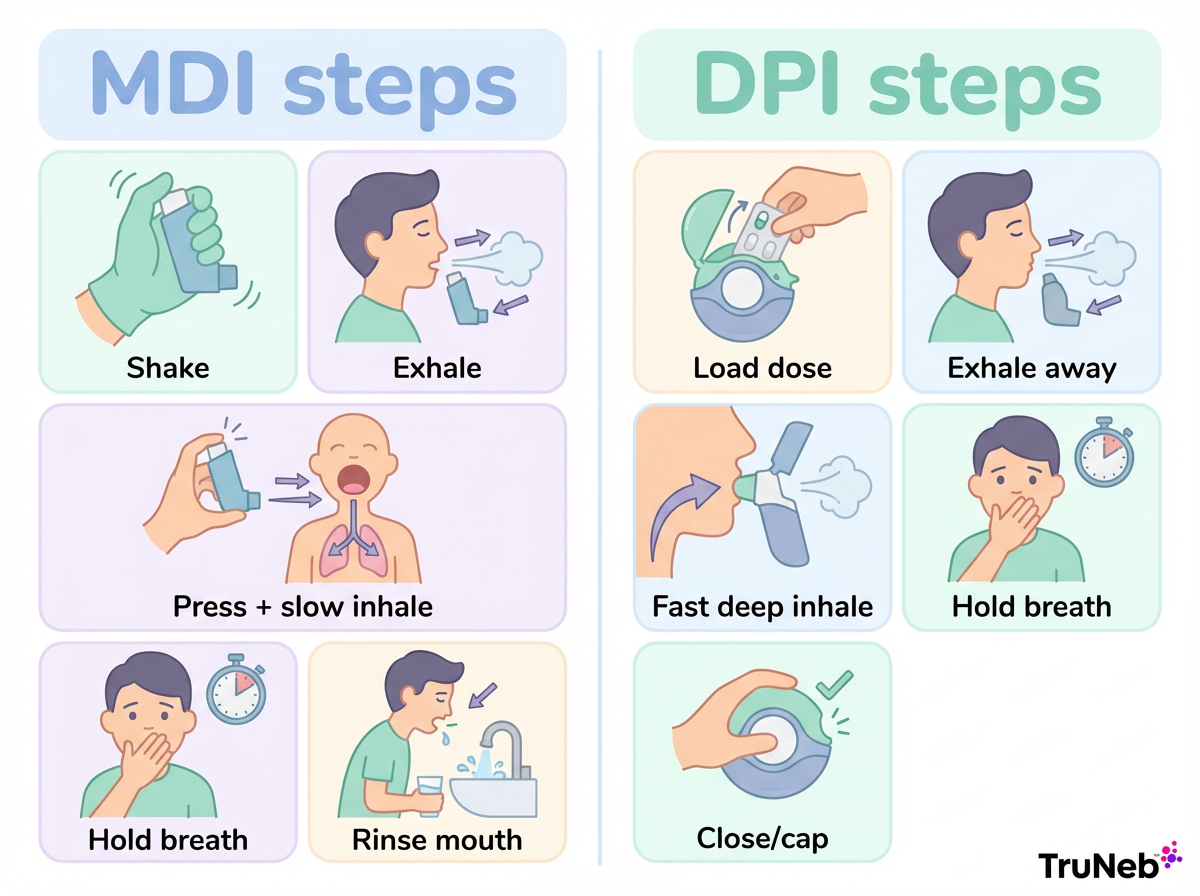
These are general technique tips; always follow the instructions that come with your inhaler and what your doctor shows you. In general, MDI instructions look like this:
- Shake the inhaler if the label says to, then remove the cap.
- Attach a spacer if you have one.
- Breathe out fully away from the mouthpiece.
- Seal your lips around the mouthpiece (or spacer mouthpiece).
- Press once as you start a slow, deep breath that lasts about 3–4 seconds.
- Hold your breath for up to 10 seconds so the medicine settles.
- Breathe out slowly. If you’re prescribed more than one puff, your instructions will usually tell you to wait a short time between puffs.
- If it’s a steroid, rinse your mouth and spit. Recap the inhaler.
If you’re not sure your technique is right, ask your doctor or nurse to watch you use your inhaler. Common errors include inhaling too fast, pressing too early or late, and not holding your breath. The main idea is to press the inhaler as you start a slow breath in, then hold your breath so the mist can settle in your lungs.
Using a Dry Powder Inhaler Correctly
Most DPIs follow a similar pattern; always check the instructions for your specific device.
- Prepare the dose (twist, slide, or insert a capsule as your device instructs).
- Breathe out fully away from the device. Avoid blowing into it, since that can ruin the dose.
- Seal your lips around the mouthpiece.
- Inhale quickly and deeply until your lungs feel full.
- Hold your breath for about 5–10 seconds, then exhale away from the device.
- Check the counter or capsule to confirm the dose, then close the device.
- If your doctor has prescribed a second dose, reload and repeat the steps as directed.
- If it’s a steroid, rinse your mouth and spit. Keep the device dry and capped.
Weak inhales, exhaling into the device, and moisture exposure are the most common problems with DPIs. If you’re not sure your technique is right, ask your doctor or nurse to watch you use your inhaler. The key with a DPI is one strong, deep breath: load the dose, breathe out away from the device, then take one strong, deep breath in through the inhaler.
Choosing Between an MDI and a DPI
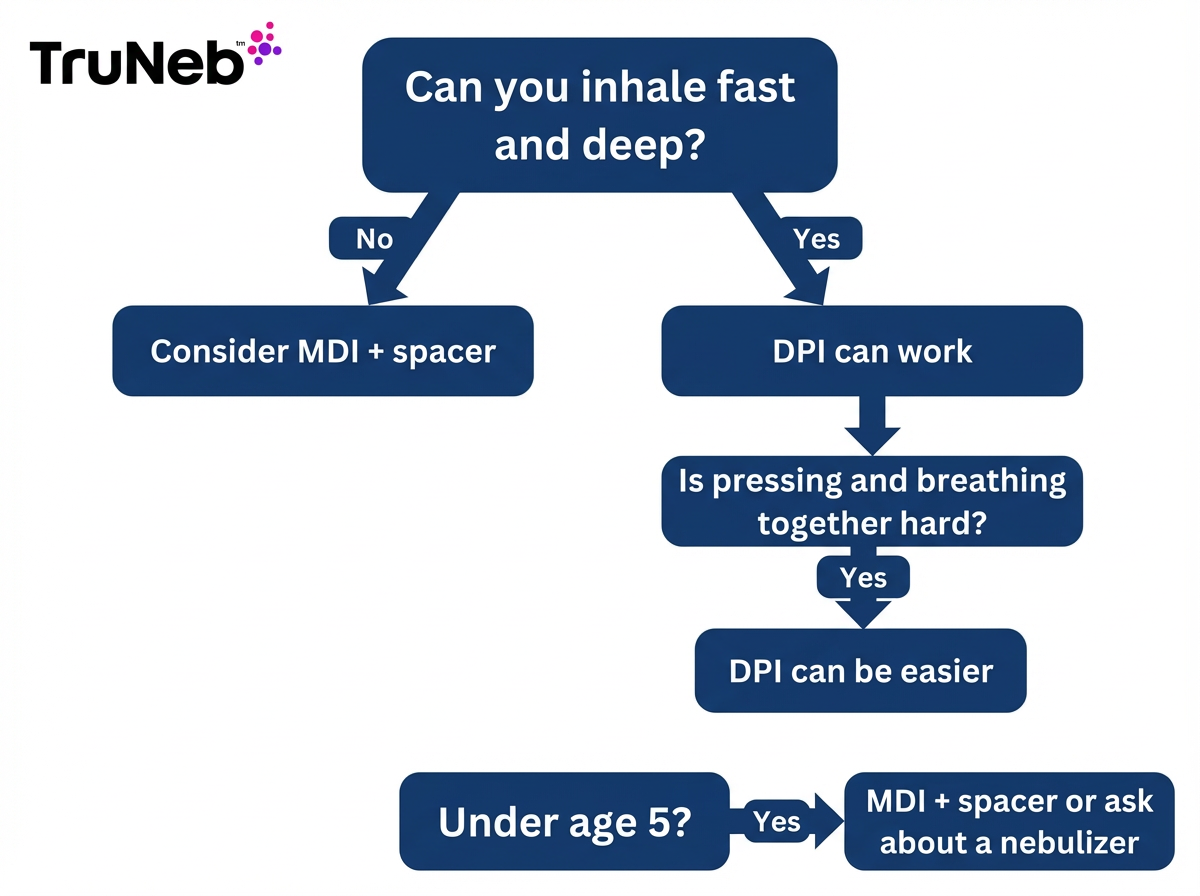
Match the device to the person. If timing the press and breath is hard, a DPI can feel simpler. If you can’t inhale quickly and deeply, an MDI (usually with a spacer) can deliver medicine more reliably. Young children usually do best with MDIs plus spacers or with a nebulizer. During bad flares, people can’t pull hard enough for a DPI. ⚠️ If you’re very short of breath, have chest pain, or can’t speak in full sentences, seek emergency medical help right away rather than relying only on your inhaler.
Ability and comfort matter. Arthritis or hand weakness can make pressing an MDI tough, and some DPIs require twisting or loading that can also be tricky, especially for older adults with weaker hands or grip strength. Try not to mix device types in one plan if you can avoid it. Switching techniques can cause confusion.
In real life, one study found that when children were switched from an MDI to a DPI for non‑medical reasons, their lung function dropped. That shows how much technique and training matter after a change. Insurance formularies and medication costs can also influence which device you’re offered, so it’s important to speak up if you’re struggling with a new device.
For safety, talk to your doctor before trying any new medication.
Key point: The best inhaler is the one you can use correctly and consistently.
Pros and Cons of MDIs and DPIs
- MDI pros: pocket‑small and familiar; can work even when your breath is shallow because the spray is pushed out; pair well with spacers; common for quick‑relief medicine.
- MDI trade‑offs: need to time the press with your breath; mouthpiece needs cleaning to prevent clogs; usually no built‑in dose counter on basic models; use propellants, which raises carbon footprint.
- DPI pros: breath‑actuated and usually have dose counters; one strong inhale can feel simpler than press‑and‑breathe timing.
- DPI trade‑offs: require a fast, deep breath; must stay dry; can’t use a spacer; some people feel throat irritation from powder.
Effectiveness depends on correct technique for both, so the ‘best’ device is the one whose pros fit your life and that you can use properly every time.
Maintenance and Care for Your Inhaler
MDI care: Wipe the mouthpiece weekly. If the canister removes, rinse the plastic holder and let it air‑dry before reassembling. Never put the metal canister in water. Recap it, store at room temperature, and prime as the label directs if it’s new or unused for a while.
DPI care: Keep it dry. Don’t wash the inside. Wipe the mouthpiece with a dry cloth, recap it, and store away from humidity. Watch the dose counter and refill before it hits zero.
Always check the expiry date and follow the cleaning instructions that come with your specific inhaler.
In short, keep MDIs clean and DPIs dry so each dose works the way it should.
When MDIs or DPIs Aren’t Enough: Nebulizers and Other Options
If inhaler technique is hard or your breath is too weak during illness, your doctor can recommend a nebulizer. A nebulizer turns liquid medicine into a fine mist you breathe normally over a few minutes. This can help infants, small children, and anyone who struggles with timing or fast inhalation. Severe flare‑ups should be treated as emergencies. In the hospital, severe flare‑ups are commonly treated with nebulizers.
⚠️ You might see products labeled ‘steam inhaler’ in stores. These are for plain steam, not for prescription medications, and they aren’t a substitute for a nebulizer.
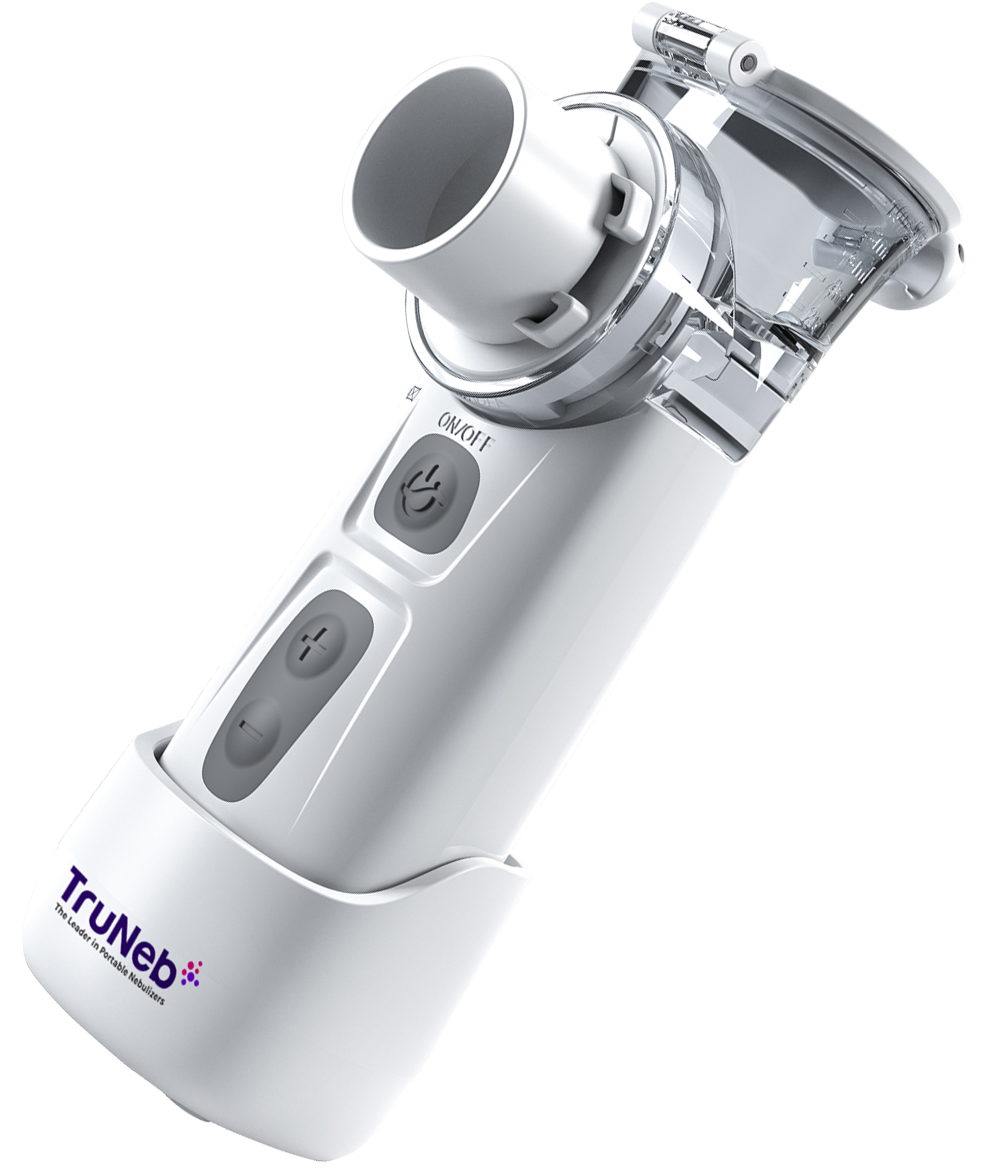
Modern portable mesh nebulizers, such as the TruNeb™ portable mesh nebulizer, are small, hand‑held devices. They can be a practical option when a doctor wants you to have a simpler way to take certain medicines. For mucus‑heavy diseases like cystic fibrosis or bronchiectasis, doctors sometimes use nebulized hypertonic saline (3% or 7%) to help clear mucus. These treatments are prescription‑only and are usually prescribed and monitored by specialists, not used on your own at home without guidance.
Your doctor can help decide if a nebulizer belongs in your plan.
Nebulizers turn liquid medicine into a mist you breathe normally, which can help when inhalers are hard to use or your breathing is very weak.
Frequently Asked Questions
Tap or click a question below to see the answer:
In studies, both devices control asthma well when technique is good; the main difference is how you use them. Rescue medicine is usually in an MDI. Plenty of daily controllers come in DPIs. The right choice is the one you use well, with your doctor’s guidance.
No. Spacers are for MDIs only. A DPI needs your direct, fast inhale and won’t work through a spacer.
Most DPIs have a dose counter. Most basic MDIs do not, so keep track of puffs or check if your device has a built‑in counter.
Yes. DPIs don’t use propellant gases, so they generally have a lower carbon footprint than MDIs.
Ask your doctor or nurse to watch your technique and teach you again. Your doctor can switch you to a device you can use better or add a spacer for an MDI. If needed, a nebulizer can be prescribed. Always check with your doctor before changing how you use your inhaler or starting any new medication.
Disclaimer: This article is for informational purposes only and is not a substitute for professional medical advice, diagnosis, or treatment. Always talk to your doctor about your symptoms, inhaler technique, and any changes to your medications or devices.