

On this page
Understanding Mesh Nebulizer Technology
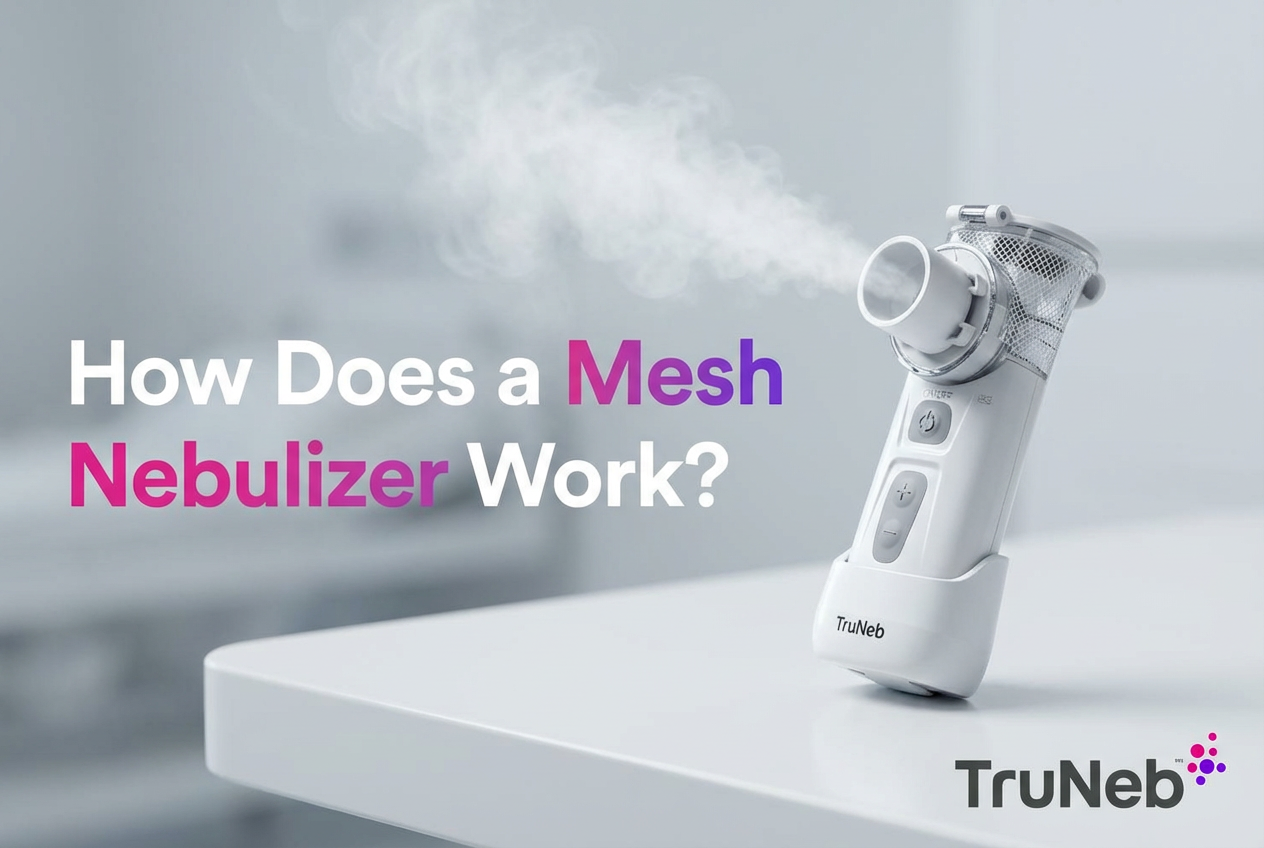
A mesh nebulizer uses vibrating mesh technology to push liquid medicine through microscopic holes and turn it into an inhalable mist.
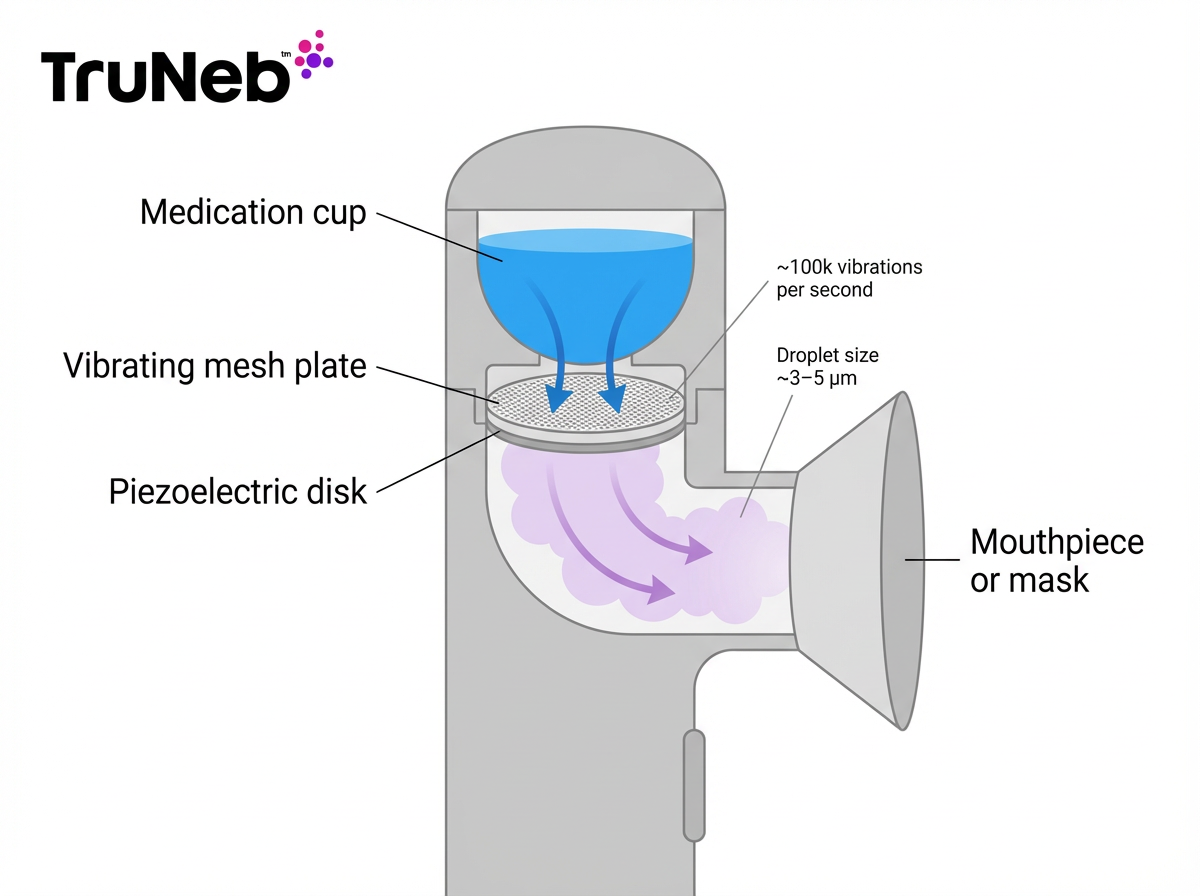
Inside the device, a small piezoelectric disk sits just behind the mesh and makes it vibrate at very high speed. Think of the mesh like a super-fast sieve. When it shakes, the liquid is pushed through thousands of tiny holes and becomes an even cloud of droplets.
Those droplets are small on purpose—most fall around 3–5 micrometers. This particle size is ideal for good lung deposition, meaning more of the medicine reaches your lower airways where it can work.
This setup is called vibrating mesh nebulizer technology and it’s the latest approach compared with older jet (compressor) and ultrasonic nebulizers.
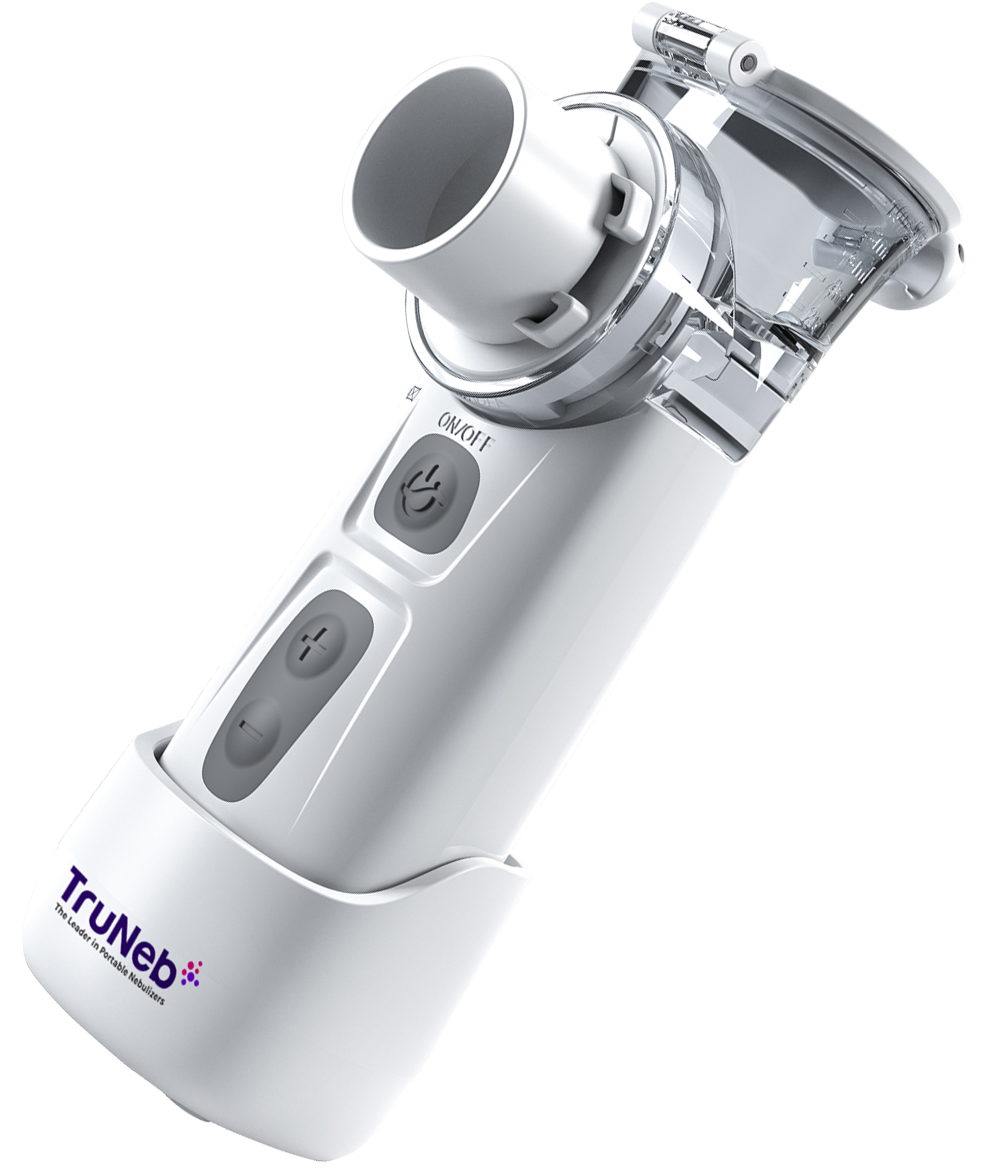
This quiet, handheld design is why many people with asthma, COPD, cystic fibrosis, and bronchitis like mesh units. In a device like the TruNeb™ portable mesh nebulizer, the piezo disk drives the mesh at ultrasonic speed so you get a steady mist within seconds.
Below, you’ll see exactly how to use and clean a mesh nebulizer at home.
Key Components of a Mesh Nebulizer and Their Roles
In a mesh nebulizer, the mesh plate, piezo disk, medicine cup, power source, and a mask or mouthpiece all work together to create and deliver the mist.
- Mesh cap or mesh plate: A thin membrane with thousands of microscopic holes. This is where the mist is made.
- Piezoelectric element (a tiny disk that vibrates when powered): It sits just behind the mesh and drives the vibration.
- Medication chamber: The small cup where you add the liquid medicine.
- Power source: Usually a rechargeable battery or USB for true portability.
- Mouthpiece or mask: The part you breathe from. Adults often use a mouthpiece; kids do better with a mask.
Together, these parts turn your dose into a smooth, quiet treatment you can take almost anywhere.
How a Vibrating Mesh Nebulizer Works Step by Step
A vibrating mesh nebulizer works by adding medicine to the cup, vibrating a tiny mesh to make mist, and having you breathe that mist in until the dose is finished.
- Add the medicine. Pour the prescribed liquid into the cup and secure the top so it won't leak.
- Power on. The device turns on the piezo disk, which starts the vibration.
- Mesh vibrates. The vibrating disk makes the mesh plate shake at ultrasonic speed. The vibration pulls liquid up to the mesh.
- Mist forms. The liquid is pushed through the tiny holes and becomes a fine, even aerosol cloud.
- You inhale the mist. Breathe in slowly through the mouthpiece or mask. The fine droplets reach deep into your lungs.
- It finishes on its own. When the cup is empty, the mist fades or the unit auto-stops, and very little liquid is usually left in the cup.
Altogether, this is how mesh nebulizers create a fine aerosol mist from liquid medicine.
Advantages of Mesh Nebulizers Over Traditional Models
Mesh nebulizers are quiet, portable, efficient, and typically finish treatments faster with less wasted medicine.
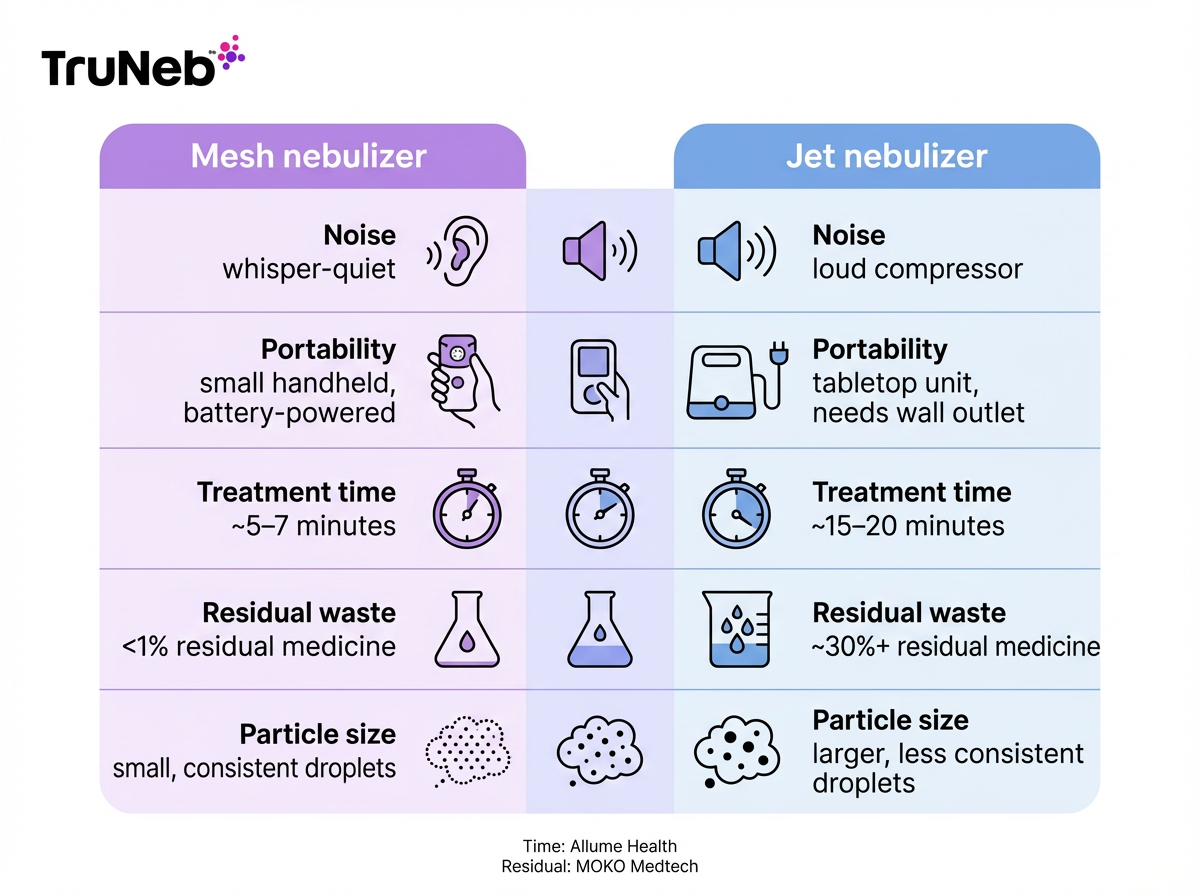
Key advantages of mesh nebulizers over jet nebulizers include quieter operation, better portability, and less wasted medicine.
- Quiet operation. No loud compressor. Just a soft hum. That makes bedtime treatments and school or work breaks much easier.
- Portable and handheld. Pocket-sized and battery-powered, so you can treat at home, in the car, or while traveling.
- Efficient lung delivery. Mesh devices make consistently fine droplets with an ideal particle size for good lung deposition, so more of the medicine reaches the lower airways. In a comparison, a mesh unit left under 1% of the dose as residue, while one jet device left more than 30% behind.
- Faster sessions. Many users finish in about 5–7 minutes. Older tabletop units usually take 15–20 minutes. Shorter time on the device makes it easier to stay on track.
- Less waste. Low residual volume means fewer leftover drops in the cup after treatment.
- Easy to use. Usually one button and no tubing. Portable nebulizers usually compact and battery-powered, so it fits easily into a busy routine.
- Medication handling. Unlike ultrasonic nebulizers, mesh nebulizers do not heat the medication and can handle a wide range of standard nebulizer solutions.
Mesh vs jet vs ultrasonic nebulizers: mesh is quieter and more portable, with consistent particle size and less residual waste.
| Feature | Mesh nebulizer | Jet (compressor) nebulizer | Ultrasonic nebulizer |
|---|---|---|---|
| Noise | Very quiet | Loud compressor | Quiet to moderate |
| Portability/power | Handheld, battery/USB | Tabletop, wall outlet | Varies; commonly tabletop |
| Particle size consistency | Consistent fine droplets | Variable, depends on flow | Fine droplets, can vary |
| Medication heating | No heating | No heating | May warm liquid |
| Residual volume after treatment | Low (can be <1%) | Higher (can be ~30%+) | Low to moderate |
| Typical treatment time | ~5–7 minutes | ~15–20 minutes | ~5–10 minutes |
| Cleaning needs | Rinse after each use; gentle care for mesh | Wash cup/tubing; more parts | Wash cup; follow manual |
Times and performance vary by model; follow your device manual.
Medications and Solutions You Can Use in a Mesh Nebulizer
Most water-based inhalation medications work well in mesh nebulizers, including 3% and 7% hypertonic saline.
- Bronchodilators: Albuterol or levalbuterol for quick relief.
- Corticosteroids: Budesonide to calm airway swelling.
- Saline: Normal saline to moisten airways, plus medical-grade hypertonic saline 3% or 7% to help clear thick mucus.
- Inhaled antibiotics or other solutions when prescribed.
Hypertonic saline and steroid suspensions should only be used as prescribed and monitored by your doctor. TruNeb is designed to nebulize medical-grade saline solutions, including 3% and 7% hypertonic saline.
What to avoid: Do not use oil-based or very thick liquids. They do not nebulize well, can harm the device, and aren't safe for breathing treatments.
⚠️ If you see products labeled "steam inhaler," remember these are not nebulizers and should not be used for prescription medications.
⚠️ If you have severe trouble breathing, chest pain, blue lips or fingertips, or can’t speak in full sentences, seek emergency medical care right away.
Safety note: Talk to your doctor before trying a new medication.
How to Use a Mesh Nebulizer: Step-by-Step Guide
Wash hands, add your dose, attach the mask or mouthpiece, press start, breathe slow until the mist stops, then clean.
Always follow the instructions from your doctor and the directions that come with your specific nebulizer. The steps below are general guidelines for how most mesh nebulizers work.
- Wash your hands. Keep germs out of the device.
- Add the medication. Pour the prescribed amount into the cup and close it securely.
- Attach the mouthpiece or mask. Make sure the fit is snug so the mist doesn't escape. For children, a mask usually gives a better seal.
- Press start. The unit will begin making a steady mist.
- Breathe in slowly through your mouth. If you can, hold the breath for a second before exhaling. Continue until the mist fades or the unit stops.
- Turn off the device. Now it's time to clean the parts you used (see the next section).
Cleaning and Maintenance of Your Mesh Nebulizer
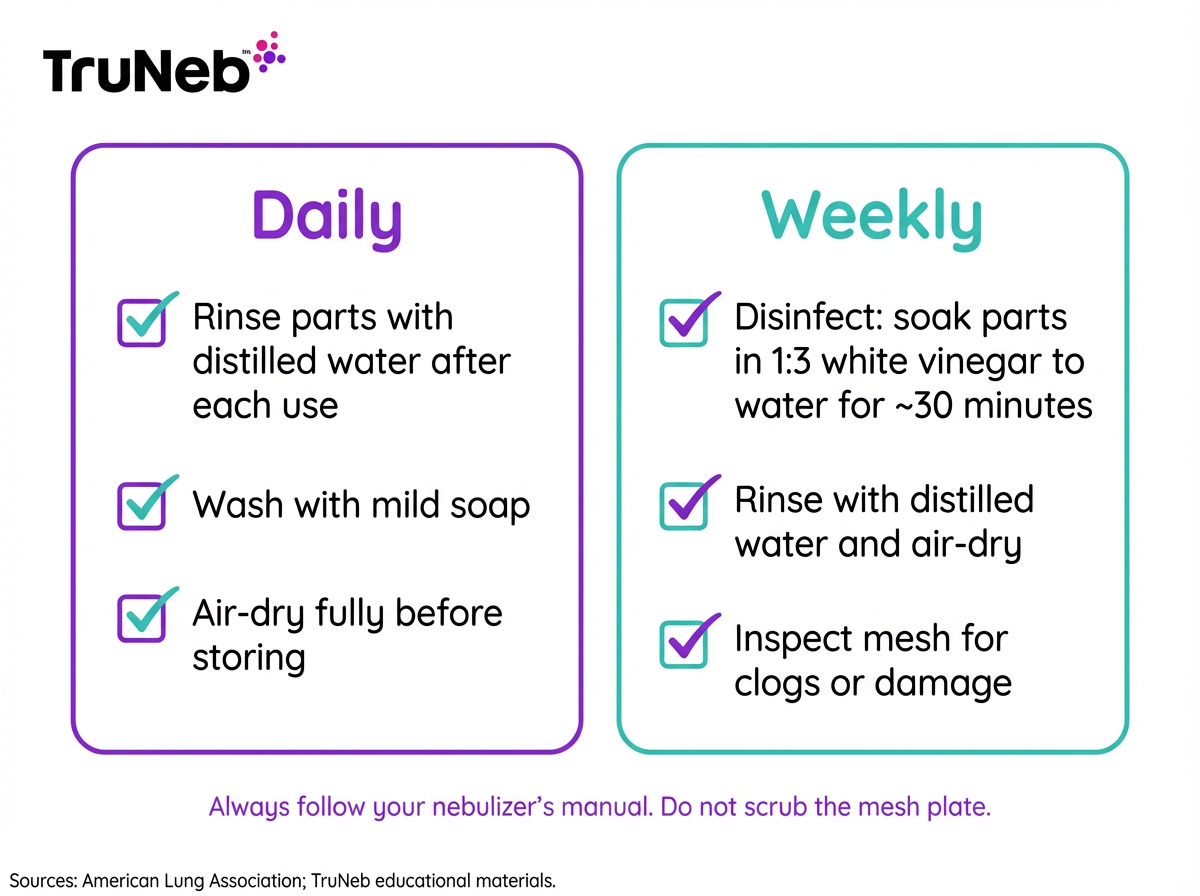
Rinse after each use, wash daily, and disinfect weekly so the tiny mesh holes stay clear and the mist stays steady.
- After each use: Rinse the medicine cup and mesh area with distilled water. Some people nebulize a small amount of distilled water for a few seconds to flush the mesh, especially after suspensions or saline.
- Daily wash: Take off the removable parts used for the treatment. Wash them in warm water with mild dish soap. Rinse well. Don't scrub the mesh with a brush or pin.
- Air-dry fully: Set parts on a clean towel and let them dry completely before storing.
- Weekly disinfect: Soak the washable parts in a 1 part white vinegar to 3 parts water solution for about 30 minutes. Rinse and air-dry. A common method, also suggested by the American Lung Association, is to soak parts in this diluted vinegar solution.
- Storage: Keep the device dry and dust-free between uses.
Do not boil or submerge the electronic base. Don't scrub the mesh—the tiny holes can be damaged.
These steps line up with guidance from groups like the American Lung Association, which recommends cleaning and disinfecting nebulizers regularly. Note: Always follow your device instructions. TruNeb’s care guidance emphasizes quick rinsing and full air-dry so the mist stays steady.
Frequently Asked Questions
Tap or click a question below to see the answer:
For most people, yes. Mesh devices are quiet, portable, and typically deliver medicine more efficiently with less waste, so sessions finish faster. Jet nebulizers still work, but they’re bulkier and louder.
Most standard inhalation medicines, such as albuterol, budesonide, and medical-grade saline (including 3% and 7% hypertonic), can be used in a mesh nebulizer. See the medications section above for more detail.
Rinse parts after each use, wash daily with mild soap, air-dry fully, and disinfect weekly (for example, a 1:3 vinegar-water soak for about 30 minutes). See the cleaning section above for full instructions.
Yes. The quiet mist and small size make mesh nebulizers kid-friendly. For children, a mask usually gives a better seal, and an adult should supervise.
Typically around 3–5 micrometers. That range helps medicine reach the lower airways and supports good lung deposition.
You usually do not need a prescription for the device itself, but medications do require one. If you want the device covered through insurance, your plan may require a prescription and approval as durable medical equipment. If you plan to use insurance, your doctor’s prescription and your plan’s rules will determine what’s covered. Some people buy a portable mesh nebulizer like TruNeb out of pocket for convenience.
Talk to your doctor if your breathing symptoms don’t improve with treatment, get worse over time, or if you’re thinking about changing your medications or how often you use your nebulizer.
Disclaimer: This article is for informational purposes only and is not a substitute for professional medical advice, diagnosis, or treatment. Always talk to your doctor about your symptoms, medications, and the best way to use any nebulizer.