

On this page
How Indoor Air Quality Affects COPD
Indoor air quality and COPD symptoms are closely linked. When your home's air holds fine particles (often called PM2.5) and fumes, your lungs have to work harder. These are very small particles that can get deep into your lungs. Common irritants include dust, pet dander, pollen, mold spores, cooking smoke, cleaning product fumes, and secondhand tobacco smoke.
For people living with chronic obstructive pulmonary disease (COPD), already‑narrowed and inflamed airways can react quickly to these triggers, leading to more coughing, wheezing, and shortness of breath. High particle levels inside a home are tied to more flare‑ups and even hospital visits. If someone smokes indoors, particle levels can be about twice as high as normal.
That’s where a good air cleaner can help if you have COPD. That’s why many people look at air purifiers for COPD as part of their home setup. By removing a large share of particles from the air you breathe, a well‑chosen device can cut down on daily irritants.
Key takeaway: Cleaner indoor air means fewer irritants hitting your lungs, which can help steady COPD symptoms for people with COPD.
Do Air Purifiers Help with COPD?
Yes, a quality air purifier can help by reducing the number of particles and allergens you inhale. Less dust, smoke, pollen, and mold in the air can mean fewer triggers and easier breathing.
What the research shows:
- A randomized trial in former smokers with COPD found that using HEPA air cleaners at home improved respiratory health markers and increased heart rate variability by about 25% (a sign of better heart health).
- Other analyses have linked cleaner indoor air to fewer symptoms in former smokers with COPD.
In everyday life, that can translate into fewer "bad breathing days" for some people.
It’s important to keep your expectations realistic. Air purifiers support your care; they don't replace medicines, oxygen, or pulmonary rehab.
You might notice:
- Fewer irritants inhaled (less coughing and throat irritation)
- Calmer nights with less bedroom dust
- Added protection during wildfire smoke days or when visitors bring in pet dander
Key takeaway: A HEPA air purifier for COPD can lower everyday triggers, but it’s an add‑on to treatment—not a replacement.
What to Look for in an Air Purifier for COPD
When you’re choosing the best air purifier for COPD patients, prioritize these features.
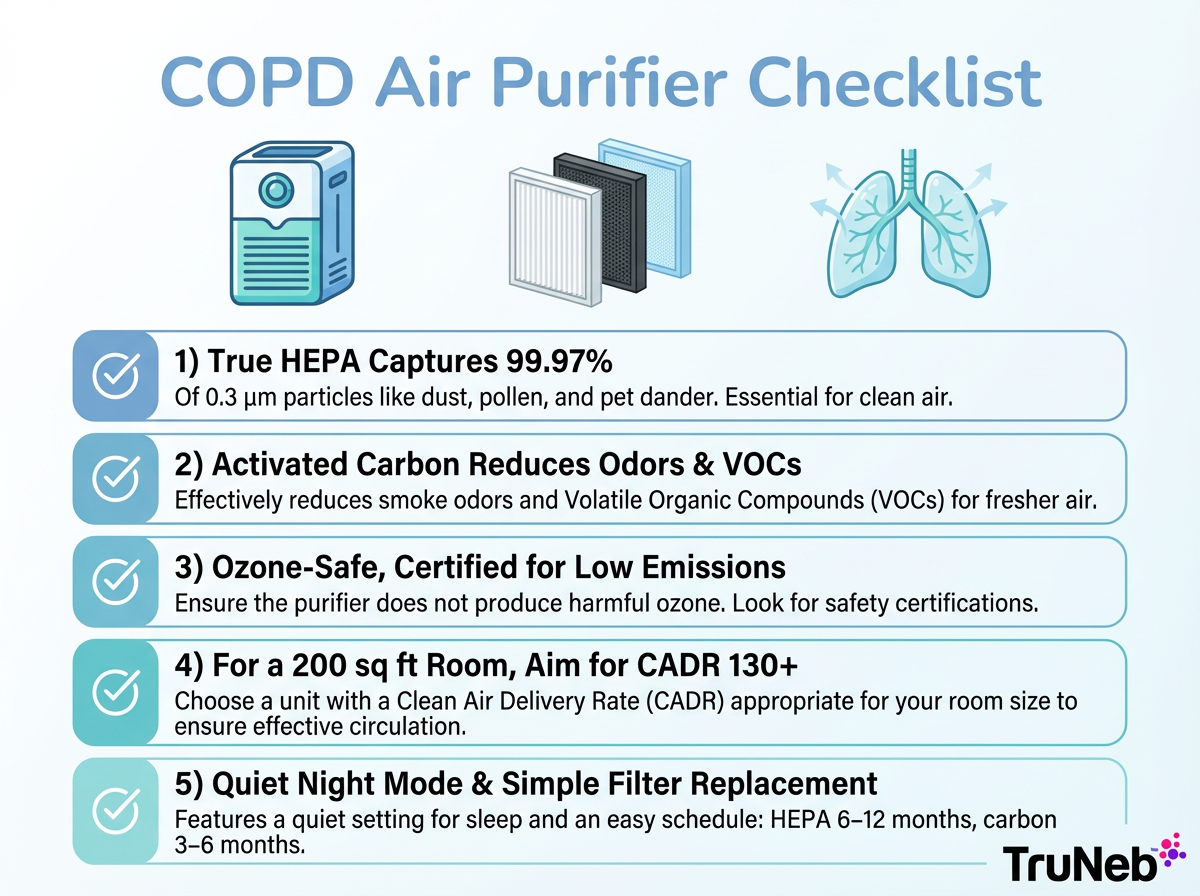
1. True HEPA filtration (and MERV basics)
Choose a unit with a True HEPA filter. True HEPA captures at least 99.97% of particles down to 0.3 microns—covering smoke, dust, pollen, and mold. If you have central air, using a higher‑MERV furnace filter (around MERV 11–13) also helps your baseline air stay cleaner—as long as your system is designed to handle that level, which an HVAC technician can confirm.
2. Activated carbon for gases and odors
HEPA traps particles, but it doesn't remove gases or smells. If smoke, cooking fumes, or chemical odors bother you, pick a purifier that includes an activated carbon (charcoal) filter to adsorb those vapors.
3. No ozone (avoid ionizers/ozone generators)
Steer clear of devices that create ozone or lack safety certification. Ozone can irritate and harm lungs. Look for models listed by the California Air Resources Board (CARB) as meeting ozone emission limits. Mechanical HEPA units are a safe bet.
4. Size, CADR, and room coverage
Match the purifier to your room size. A higher Clean Air Delivery Rate (CADR) means faster cleaning. Aim for a CADR that fits your room’s square footage so the air turns over several times each hour. For example, a CADR in the 130+ range is typically suitable for a 200 sq ft room. One portable purifier cleans one room at a time.
5. Noise and maintenance
You’re more likely to run a quieter purifier all day and at night. Check decibel levels and look for a low "night" mode. Plan for filter upkeep: HEPA filters typically last 6–12 months; carbon filters usually need replacing every 3–6 months, depending on use. Washable pre‑filters can extend filter life.
Key takeaway: Pick a True HEPA, ozone‑safe purifier with the right CADR for your room, plus carbon if smoke or odors are an issue.
Placement and Usage Tips for Your Air Purifier
How you set it up and use it each day matters just as much as the model you buy.
Placement and use:
- Put the purifier in the room you use most (usually the bedroom for overnight relief, plus your main living area during the day).
- Run it regularly, ideally 24/7 on a comfortable speed. Consistent cleaning keeps particle levels down.
- Keep doors and windows closed when it’s running, especially when outdoor air quality is poor (wildfire smoke, high traffic, high pollen).
- Don’t block the intake or exhaust. Give the unit a few inches of clearance from walls and furniture so air can move freely.
- If your home has central air, use a higher‑MERV furnace filter (around MERV 11–13) and change it on schedule. That supports the purifier’s work.
Key takeaway: Place it where you spend time, keep windows closed when outdoor air is poor, and run it consistently for the best results.
Keeping Your Home’s Air Clean
- No smoking indoors; even the best purifier can’t fully overcome active smoking.
- Ventilate when it’s safe to do so. Use kitchen and bath fans; open windows when outdoor air is clean.
- Clean regularly. Vacuum with a HEPA vacuum and damp‑dust surfaces so dust doesn’t keep recirculating.
- Control humidity. Aim for about 40–50% to reduce mold growth and airway irritation. If you use a humidifier, keep it clean.
- Go easy on strong fragrances and chemicals. Limit scented candles, aerosols, and harsh cleaning products.
Key takeaway: Cutting indoor smoke, dust, moisture problems, and harsh fumes works together with your air purifier to create a COPD‑friendlier home.
What Air Purifiers Can and Cannot Do for COPD
What they can do:
- Remove a large share of airborne particles, which can reduce day‑to‑day irritation and help steady symptoms.
- Make bedrooms more comfortable at night by lowering dust and allergens.
- Lessen overall pollutant load during high‑smoke or high‑pollen periods.
What they cannot do:
- Cure COPD or reverse lung damage.
- Replace inhalers, nebulized medicines, oxygen, or pulmonary rehab.
- Add oxygen or replace prescribed oxygen therapy, or remove every gas or germ in the air.
Think of a purifier as a helpful teammate: it reduces the triggers outside your lungs while your prescribed therapies treat what's happening inside your lungs.
To fully manage COPD at home, you’ll also rely on medical treatments and tools alongside cleaner air.
Key takeaway: Purifiers cut triggers; they don’t cure COPD or replace your prescribed care.
Beyond Air Purifiers: Managing COPD at Home
Clean air helps, and so does getting medicine where it needs to go.
Many people with COPD use inhaled treatments.
Nebulizers turn liquid medicine or saline into a fine mist you breathe in naturally.
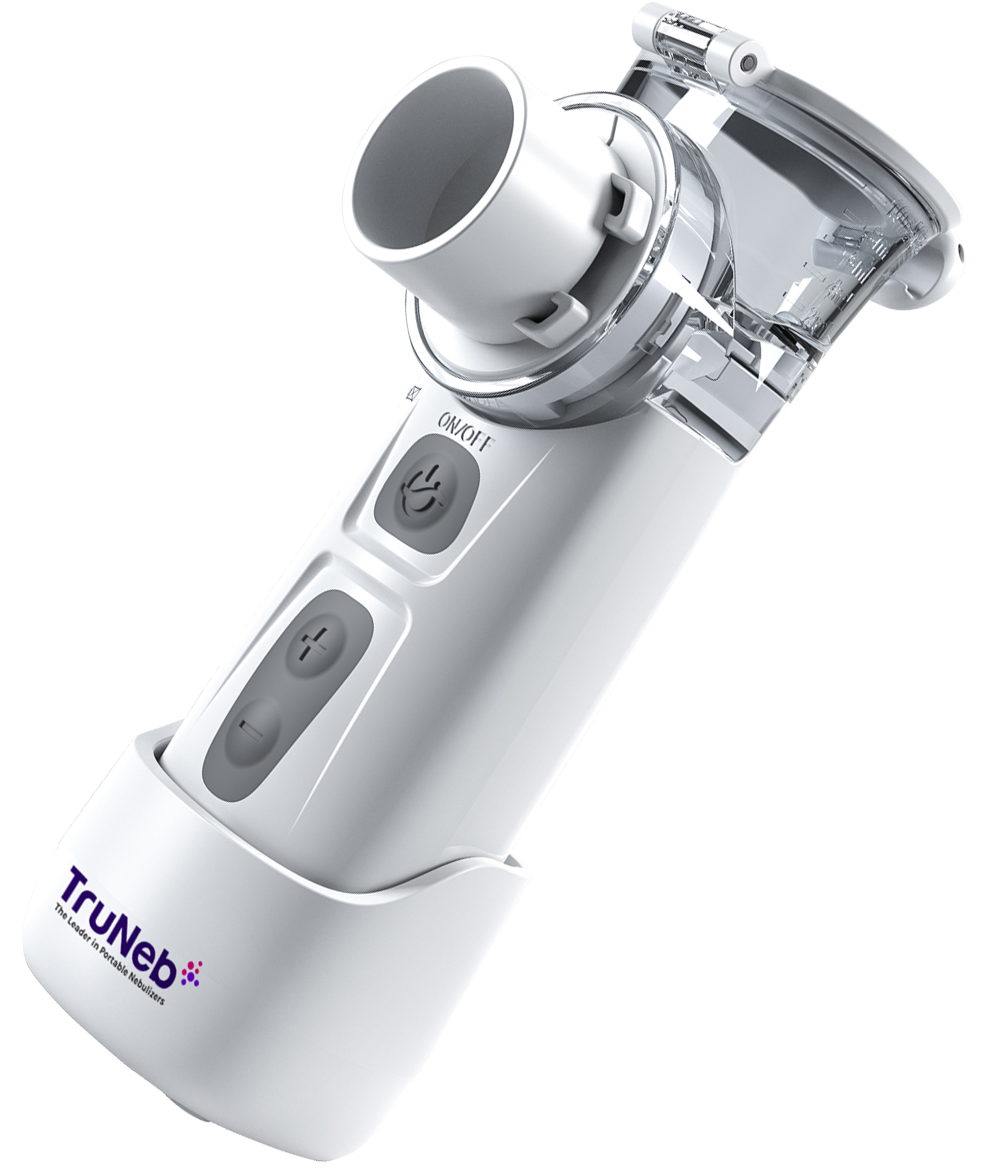
A portable mesh nebulizer, such as the TruNeb™ nebulizer, can make treatments easier to take at home or on the go. Nebulized hypertonic saline (3% or 7%), when prescribed, can help thin mucus so it’s easier to clear. Hypertonic saline isn’t right for every person with COPD, especially if you have certain heart or kidney conditions—your doctor can advise you.
Other helpful pieces of a home toolkit can include a spacer for inhalers, a pulse oximeter to spot‑check oxygen levels, and keeping up the breathing exercises you learned in pulmonary rehab.
Safety note: Talk to your doctor before trying a new medication or saline strength, and never change your prescription without medical guidance. An air purifier complements your care; it doesn’t replace inhalers, nebulizer medicines, oxygen, or rehab.
If your COPD symptoms get worse or your usual treatments stop working as well, talk with your doctor promptly.
⚠️ If you have severe shortness of breath, chest pain, confusion, or blue lips or fingers, call 911 or seek emergency care right away.
Key takeaway: Pair clean air with the right therapies—filter the air outside your lungs and treat the air inside them.
Frequently Asked Questions
Tap or click a question below to see the answer:
Choose a True HEPA purifier that's ozone-safe. If smoke or odors are a concern, pick a model with an activated carbon filter. Avoid ionizers or ozone generators; look for CARB-listed devices sized for your room.
They do different jobs. An air purifier removes particles and pollutants; a humidifier does not remove particles—it adds moisture, which can help if your air is very dry. Some people use both, and clean, moderately humid air usually feels best; keep humidifiers clean to prevent mold or bacteria.
A HEPA + carbon purifier can reduce smoke particles and some odors, but no device can fully overcome active indoor smoking. Use it as back-up protection.
For steady results, run it continuously in rooms you use most. At a minimum, turn it on a few hours before you're in the room and keep it on while you're there, including overnight in the bedroom.
Let your doctor know about any new steps you're trying at home. While a purifier is a lifestyle device, nebulized medications and saline require medical guidance. Your care team can tailor advice to your needs.
Key takeaway: For COPD, the safest choice is a True HEPA, ozone-safe purifier used consistently, alongside doctor-guided treatments.
Disclaimer: This article is for informational purposes only and is not a substitute for professional medical advice, diagnosis, or treatment. Always talk with your doctor about your symptoms, questions, and treatment options.